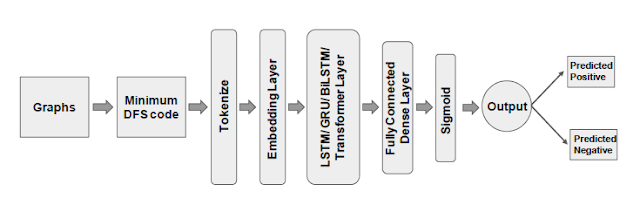
Graph Classification with Minimum DFS Code: Improving Graph Neural Network Expressivity A summary of the IEEE BigData 2021 research paper by Jhalak Gupta and Arijit Khan [presented in Machine Learning on Big Data (MLBD 2021), special session of IEEE BigData 2021]. Background: Graph Classification Given a set of graphs with different structures and sizes, the graph classification problem predicts the class labels of unseen graphs [1, 2, 3]. Developing machine learning tools for classifying graphs can be found in cheminformatics [1, 4] and bioinformatics [6], malware detection [7], telecommunication networks, internet-of-things [8], trajectories and social networks [9]. This is challenging because network data contain graphs with different numbers of nodes and edges, and a generic node order is often not available. Graphs do not have regular grid structures, since the neighborhood size of each node differs. The lack of ordered vector represent...
Posts
- Get link
- X
- Other Apps
Multi-relation Graph Summarization A summary of the ACM Transactions on Knowledge Discovery from Data (TKDD) Journal 2021 research paper by Xiangyu Ke, Arijit Khan, and Francesco Bonchi Background: Multi-relation Graphs Multi-relation networks (also known as multi-layer, multiplex, or multi-dimensional networks) are graphs where multiple edges of different types may exist between any pair of nodes [7]. Multi-relation graphs are an expressive model of real-world activities, in which a relation can be a topic in social networks, an interaction type in genetic networks, or a snapshot in temporal graphs. For instance, BioGRID (thebiogrid.org) describes seven different types of genetic interactions between genes in Homo Sapiens. STRING (string-db.org) models protein-to-protein interactions with six types of correlations statistically learned from existing protein databases, revealing that most protein interactions are associated with at least two types of cor...
- Get link
- X
- Other Apps
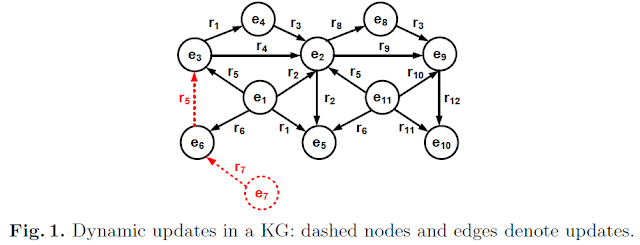
Online Updates of Knowledge Graph Embedding A summary of the COMPLEX NETWORKS 2021 research paper by Luo Fei, Tianxing Wu, and Arijit Khan [Background: Knowledge Graphs and Embedding] Knowledge graph is a data model for complex networks to manage large-scale and real-world facts [1, 2]. Examples include DBpedia [3], YAGO [4], Freebase [5], NELL [6], personalized health knowledge graphs [7], etc., where a node represents an entity, and an edge denotes a relationship between two entities. Knowledge graph embedding [8, 9] is increasingly becoming popular, which aims to represent each relation and entity in a knowledge graph G as a d-dimensional vector, such that the original structure and relations in G are approximately preserved in this semantic space. KG embeddings are used in downstream applications, e.g., link prediction [10, 11, 12], entity classification [13], question answering [1, 14], KG completion [15], and recommender systems [16]. [Our Problem: Dynamic...
- Get link
- X
- Other Apps
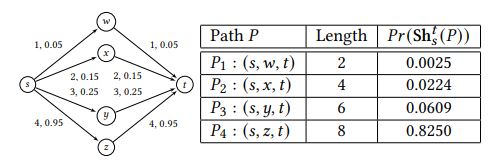
Shortest Paths and Centrality in Uncertain Networks A summary of the PVLDB 2021 research paper by Arkaprava Saha, Ruben Brokkelkamp, Yllka Velaj, Arijit Khan, and Francesco Bonchi [Background: Uncertain Graph and Shortest Path] Uncertain networks, i.e., graphs where each edge is associated with a probability of existence, have received a great deal of attention thanks to their expressivity and applicability in many real world contexts. Uncertainty in a network might arise due to noisy measurements [2], edge imputation using inference and prediction models [1, 3], and explicit manipulation of edges, e.g., for privacy purposes [4]. Researchers have studied 𝑘-nearest neighbor queries [5, 6], reachability queries [7], clustering [8], sampling [9], network design [10], and embedding [11], just to mention a few. Shortest-path queries [12, 13, 14], on the other hand, are one of the fundamental graph primitives with a plethora of applications, e.g.,...